
Reverse engineering samples into drawings and finished aluminium products.
Sometimes a project does not start with a drawing.
It starts with a part.
A profile pulled from an old system
A competitor sample
A legacy component with no paperwork
Or something that just needs to be replicated better
This is where reverse engineering comes in.
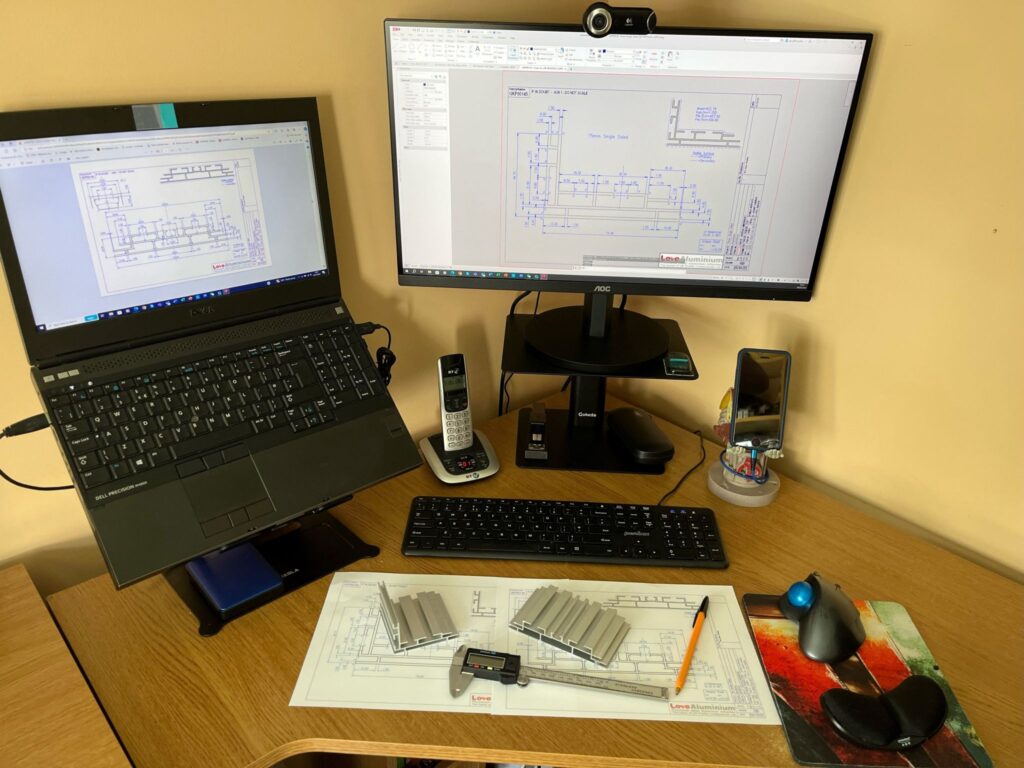
At Love Aluminium, we regularly take physical samples and turn them into accurate drawings and fully manufactured aluminium products ready for repeat supply.
What reverse engineering actually means
Reverse engineering is the process of taking an existing physical component and working backwards to create precise technical drawings and specifications.
Those drawings then become the foundation for tooling, extrusion, machining, finishing, and long-term production.
It bridges the gap between “this is what we have” and “this is what we need to make”.

When reverse engineering is useful
Reverse engineering is commonly used when
• Original drawings are lost or never existed
• A supplier has stopped producing a profile
• A part needs improving without changing form or fit
• A system must remain compatible with existing components
• You want control over your own tooling and supply chain
We often see this with lighting systems, architectural profiles, signage, enclosures, and industrial frameworks.
Step 1: Analysing the physical sample
Everything starts with the sample itself.
We measure and analyse
• Overall dimensions
• Wall thicknesses
• Internal voids and tolerances
• Functional features such as snap fits, grooves, or thermal paths
• Signs of wear, distortion, or manufacturing shortcuts
This step is critical. A millimetre here or there can be the difference between a perfect fit and a costly problem later.
Step 2: Creating accurate CAD drawings
Once measured, the profile is recreated as a detailed CAD drawing.
This is not just a traced outline.
We factor in
• Extrusion feasibility
• Press capabilities
• Alloy selection
• Tolerance standards
• Tooling allowances
The result is a drawing that works in the real world, not just on screen.
Step 3: Optimising the design if required
Reverse engineering does not have to mean copying mistakes.
Where appropriate, we can
• Improve strength to weight ratio
• Adjust wall thickness for better extrusion flow
• Enhance thermal performance
• Simplify machining
• Reduce material usage and cost
All while keeping the external dimensions and function exactly the same.
Step 4: Tooling and extrusion
Once the drawing is approved, we move into production.
This includes
• Designing and manufacturing the extrusion die
• Sampling and first article approval
• Extrusion on the correct press size
• Quality checks against the drawing
At this stage, the reverse-engineered part becomes a controlled, repeatable product.
Step 5: Finishing, fabrication, and delivery
From there, the profile can be fully finished and supplied as required.
Common options include
• Cutting to length
• CNC machining
• Drilling and tapping
• Anodising or powder coating
• Assembly and packaging
You receive a finished product, not just raw extrusion.
Why this matters long term
Reverse engineering gives you ownership.
Ownership of
• Your drawings
• Your tooling
• Your supply chain
• Your product consistency
It removes dependency on single suppliers and protects you from future disruption.
Turning a sample into a reliable product
If you have a physical aluminium sample and need it turned into a proper drawing and a repeatable manufactured product, reverse engineering is often the smartest route.
From one off samples to long term production runs, we manage the entire process from measurement to delivery.
If you have a part on your desk and no drawing to go with it, that is usually the perfect place to start.
Get in touch today to discuss your project requirements.


